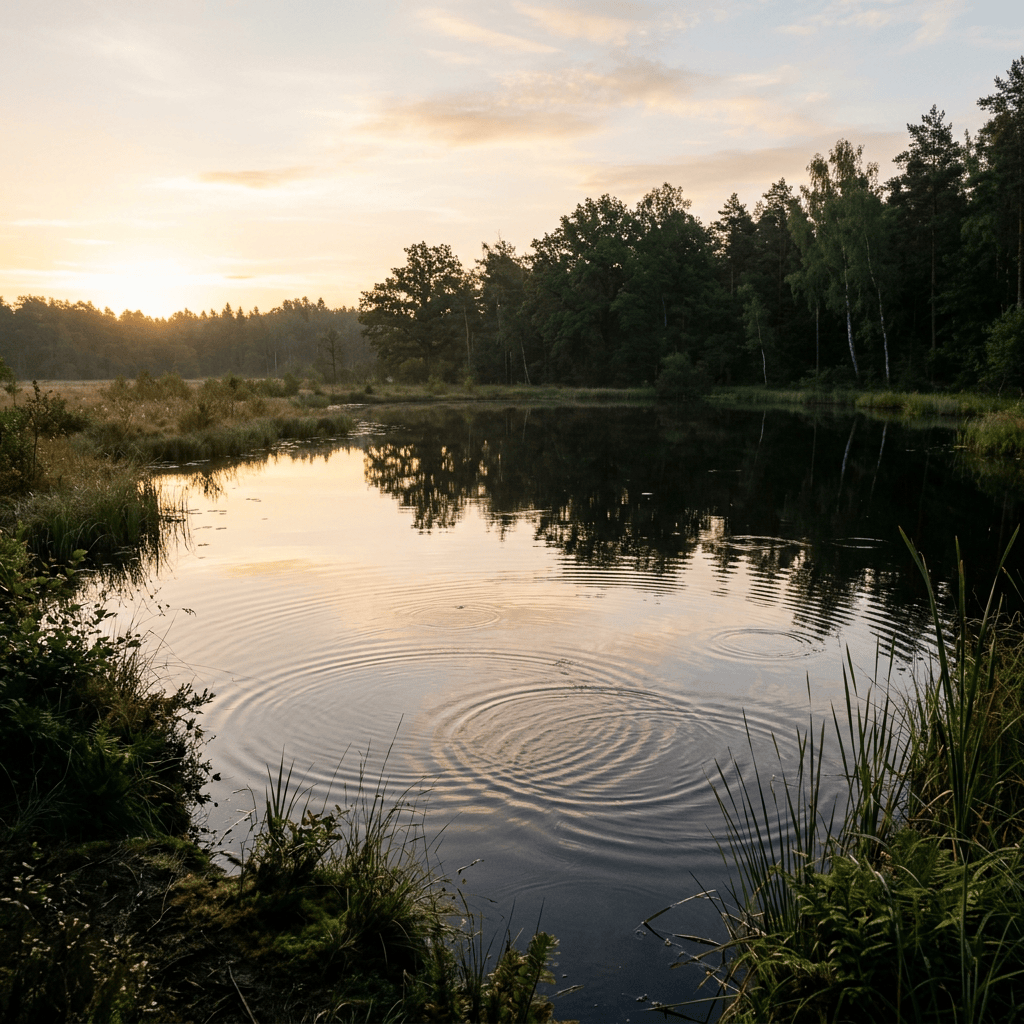
You and your friend go down to a small placid pond. You have identical stones. On the count of three, you toss them simultaneously into the pond, close enough together that the resultant waves overlap (it’s a small pond, not a puddle). The arcs of your two stones are identical. The stones hit the water at the same time in different places and rippling waves spread out from where they each broke the surface.
As every surfer knows, waves have peaks and troughs. If the peak of one of your waves hits the peak of one of your friend’s waves, they will combine to make one larger wave. That’s called constructive interference. If the peak of your wave hits the trough of your friend’s wave, the two waves will cancel each other out. That’s called destructive interference.
(Your little trip to the pond with your friend and what you observed when you tossed in stones has implications for quantum mechanics, superposition, and the possibility that we might live in a multiverse. Pursue that on your own. It’s quite fascinating.)
Now, shift into metaphoric mode, carry the idea over into the symbolism of the metaphysical. You and your pond-visiting friend both have agency. You can both act in the world with real consequences that will result from your actions. Your actions are freely chosen. You have real choices that have real effects.
(What I just wrote is not universally accepted. Philosophically, hard determinism and soft determinism are possibilities. Theologically, the strict Calvinist view maintains that everything is predetermined and directed by God. Pursue that on your own if you like. I hold to a philosophical and theological view that permits the introduction of true freedom. I think God knows all that can be known but is not a puppet master.)
Back to the pond. Some waves cancel each other out because the trough of one hit the peak of another; other waves get bigger because two peaks collided. Destructive and constructive interference, respectively.
As I gaze meditatively at the pond with its ripples, my mind turns to life as a human being. I make decisions. Most of them are tiny and relatively inconsequential, but each little decision has consequences. I decide to drive home this way instead of that and I spot a bald eagle I would have otherwise missed. I decide to sleep in, and I miss a pretty sunrise. Each little decision is like a pebble in the pond. Each result (eagle, missed sunrise) is like the tiny waves from the pebbles.
I interact with other human beings. We exchange ideas. My belief that Haitian immigrants should be treated with dignity and respect might be seen (from my perspective) as a wave-peak. The other guy’s belief that Haitian immigrants are a threat might be seen (from my perspective) as a wave-trough. My belief collides with his belief, and they cancel each other out in the sense that our conversation goes nowhere. Neither of us has affected the other. No minds were changed.
I interact with another human. We exchange ideas. My belief that homeless people are victims of an unjust economic system might be represented (from my perspective) as a wave-peak. The other person’s belief that, while my point may be well taken, the number of homeless people in a particular area is causing undue disruption to normal life might also be represented by a wave-peak. The two ideas, like wave peaks, enhance each other. As a result of our interaction, we both have a better understanding of the issue, which might lead us to plausible solutions.
The biblical proverb says iron sharpens iron. When we genuinely, open-mindedly, respectfully listen to one another, expansive ideas emerge. We learn from one another.
Perhaps you’ve noticed that some of the best art emerges from community. Examples abound:
- Laurel Canyon where David Crosby, Stephen Stills, Graham Nash, Joni Mitchell, and Brian Wilson influenced one another.
- Greenwich Village where folk musicians including Bob Dylan, Joan Baez, and Dave Van Ronk played in iconic venues like Café Wha? and Gerde’s Folk City.
- The still-vibrant artist colony in Provincetown on the tip of Cape Cod founded in 1899 by Charles Hawthorne.
- Gertrude Stein’s “Lost Generation” of authors in 1920s Paris that included Ernest Hemingway, F. Scott Fitzgerald, James Joyce, E, E. Cummings, Ezra Pound, and T. S. Eliot.
- Also in Paris during the same era Pablo Picasso, Henri Matisse, and Cole Porter interacted with dancers, singers, musicians, poets, and authors.
- The Beatles, Mike Love (Beach Boys), and Mia Farrow studying Transcendental Meditation with Maharishi Mahesh Yogi in early 1968.
- The Oxford Inklings that included C.S. Lewis, J.R.R. Tolkien, Charles Williams, Owen Barfield, Warren Lewis, Hugo Dyson, Nevill Coghill, and Dr. R. E. Havard, among others.
Similarly, in colleges and universities, creative people in a multiplicity of disciplines interact, discuss, challenge, push back, and reinforce one another. Waves of ideas, troughs and peaks help deconstruct not-so-well-thought-through concepts and construct more solid ones.
Diversity is vital in that regard. When I read theology, philosophy, or psychology, I appreciate the viewpoints of the canon that primarily consists of men of northern European heritage, but I also appreciate, in fact I desperately need, the viewpoints of feminists, womanists, and people from Africa, Asia, and Latin America. Without their perspectives, my views are in an arrested state.
For all they had in common, Parisian writers were very different individuals. Mia Farrow didn’t join the Beatles. Each Provincetown art studio is unique. Tolkien didn’t care for the Chronicles of Narnia. When creative minds get together, the sum is greater than any of the individual parts. Generally speaking, highly creative people can support and challenge the ideas of others. They provide constructive interference and deconstructive interference.
Community did not sink them into mindless homogenized groupthink; it enhanced their individuality and bolstered their creativity. That happened because they were open, teachable, humble enough to know they might need to adjust their ideas, and communicative. It also happened because they were all strong, self-actualized individuals who were not about to follow a herd. Critics on the sideline meant little to them. Their art was paramount. They influenced each other without copying each other.
Central to Jungian individuation is the idea that authentic community need not extinguish individuality; conversely, genuine individuality can make community more creative. This is likewise compatible with Kierkegaard’s insistence on the responsibility of the single individual rather than the unreflective conformity of the crowd.
Of course, therein lies the rub. These creative folks had open, teachable minds and calm demeanors that could calmly discuss differing, sometimes conflicting, ideas over a cup of coffee, a glass of wine, or a couple of doobies without hating each other. We seem to have lost that. Now, we scream slogans at each other. Blame social media silos, innate prejudices, poor education, conspiracy theories, or sinful hearts – whatever the causes, we seem to have lost the ability to collaborate. Rather than waves of ideas reinforcing or canceling one another, we ignore the pond and throw rocks at each other.
Forget drive-throughs – bring back the long, lingering conversations in coffee shops, dorm rooms, living rooms, corners of libraries, on quadrangle greens, around firesides and campsites, and in old world pubs. Strive to be teachable but not naïve. Resist the urge to fit in, always agree, or adopt the opinions of others just so they will like you. Resist the urge to argue, convince, or persuade. Take a cue from the scientists, professors, folk singers, authors, poets, and artists who are individuated, independent, and openly collaborative. Learn who you are. Know what you believe. Be willing to change what you believe in light of new evidence. Entertain the distinct possibility that we all have much to learn. And understand that you have much to offer.


Leave a Reply